
How long do you have to keep employee records in Singapore?
Two years is how much of the record you hold. One year is how long you hold it after someone leaves. The two get mixed up constantly, and the tax rule runs longer than both.
“Two years” does not mean you keep an employee’s records for two years.
That is where employment records get confusing.
Two years is how much you hold. One year is how long you hold it
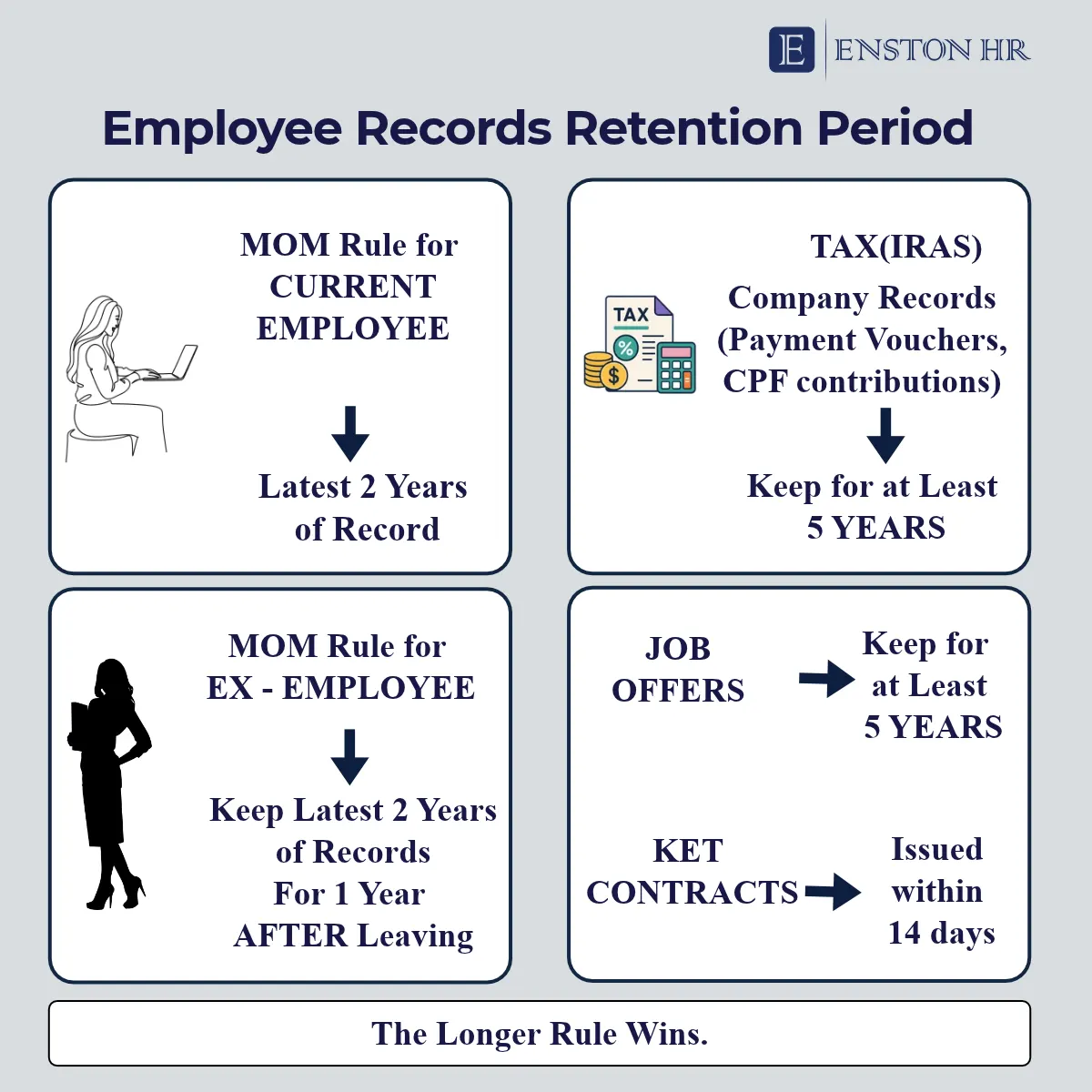
For current employees, MOM requires the latest two years of employee records.
For ex-employees the rule changes. The last two years of records must be kept for one year after the employee leaves.
So there are two different things. Two years is how much of the record you hold. One year is how long you hold it after someone goes. These get mixed up all the time.
The clock runs from each entry, not from the leaving date
The underlying law makes the distinction clearer. Under Regulation 5 of the Employment (Employment Records, Key Employment Terms and Pay Slips) Regulations 2016, the two-year period runs from when each relevant entry is made. It does not simply start when the employee leaves.
Pay slip records follow the same periods.
Key employment terms sit outside this
They must be given to the employee within 14 days of starting. But the law does not state a retention period for them.
Tax runs longer than MOM
IRAS requires company records to be kept for at least five years from the relevant Year of Assessment. Payment vouchers for staff remuneration and employer CPF contributions are on that list.
So a payroll file that may be dropped after one year under the MOM rule can still be a tax record for another four years. The longer rule wins.
Some records have no stated period at all
Interview and job offer records should be kept for at least one year, in case there is a discriminatory hiring complaint.
Others have nothing stated. There is no retention period for CPF records in the CPF Act. There is no stated work-pass record retention period for EP or S Pass employers either.
What to do about it
Do not use the MOM rule alone. Take each type of record and check every requirement that touches it, then keep it for the longest period that applies.
The records most companies lose early are the ones that looked like MOM’s problem and were really IRAS’s.
Enston HR handles payroll and work passes in Singapore.